Are you familiar with the dead internet theory?
If not, I’ll share the abridged version— the idea, at its core, is that we’re moving towards an internet which is inundated with bot accounts and generated content, rapidly shrinking its dependence on actual human input. The concern from the original (conspiracy) theorist, is that this robot-ification of the web could be used for harm, easily allowing for a few bad actors to control people’s thoughts and opinions at the click of a button, supported by a massive amount of AI resources working 24/7 for them.
That last part is what made the theory another throwaway Reddit post from over a decade ago— but you can’t tell me that the first part wasn’t a dead-on prediction.
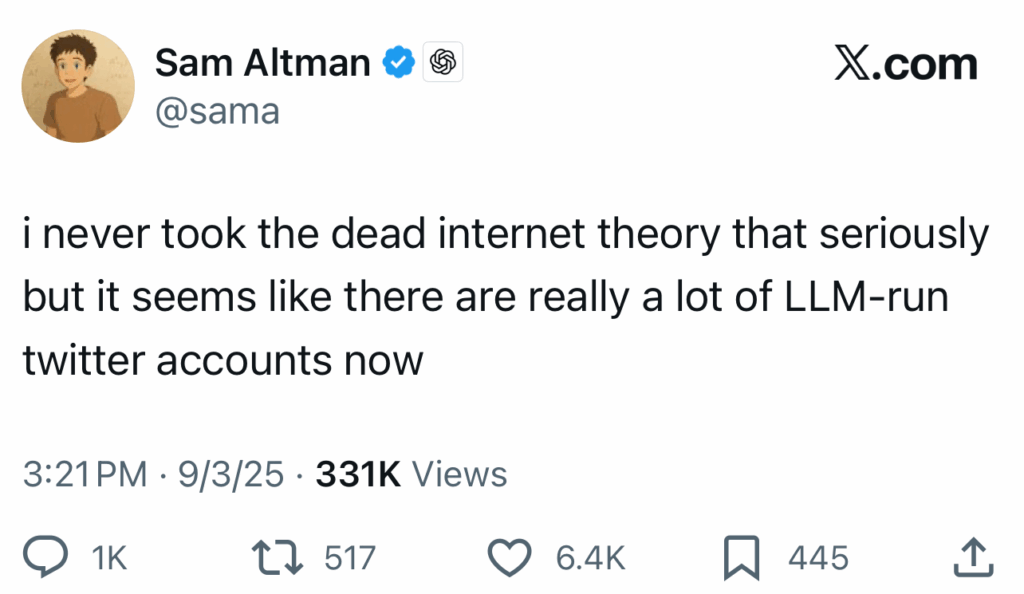
This week from Sam Altman, CEO of OpenAI
Personally, the last two years on the internet have increasingly felt like I’m in the crowd at an AI tennis match, watching as two computers mush instagram captions and fake comments back and forth at each other. Platform allowances are a big part of this, no doubt: the biggest winners in the social media world have been the teams who have figured out how to create apps and algorithms which require seemingly no input. You no longer need to post on social media to experience it, and you certainly don’t need to choose what you want to see either.
This internet apathy is also amplified by our broader lived experience. Curated, hyperpersonal digital moments have leached into our offline lives— take the rise of the term bowlslop as an example. Defined by mobile-orderable, BlackRock-backed takeout spots like Chipotle, Sweetgreen, and Cava, where all of the ingredients are scooped into a biodegradable container that gets shaken and eaten at standing desks across the corporate world, this term is a recognition that food has become reduced to its most elementary form, just sustenance and flavors, where even the bowl itself will eventually degrade and disappear so we don’t have to think about its existence anymore after an hour break for lunch.
The Dead Internet Theory and bowlslop are both ultimately a reaction to our current digital and economic condition, the same forces which are also driving the new marketing landscape in the age of AI— everything that can be commodified and personalized will be done to the point that it loses all collective meaning. Assuming that you’re reading this from the perspective of somebody who works in or around marketing then, you can imagine how the term Marketingslop has come to be.
Rather than explaining it, I want to define it through the lens of this series of AI generated posts from an account which has absolutely inundated my Instagram Reels for the past few weeks. Every post is an AI generated woman trying to convince me to let this company take over my brand’s digital footprint:
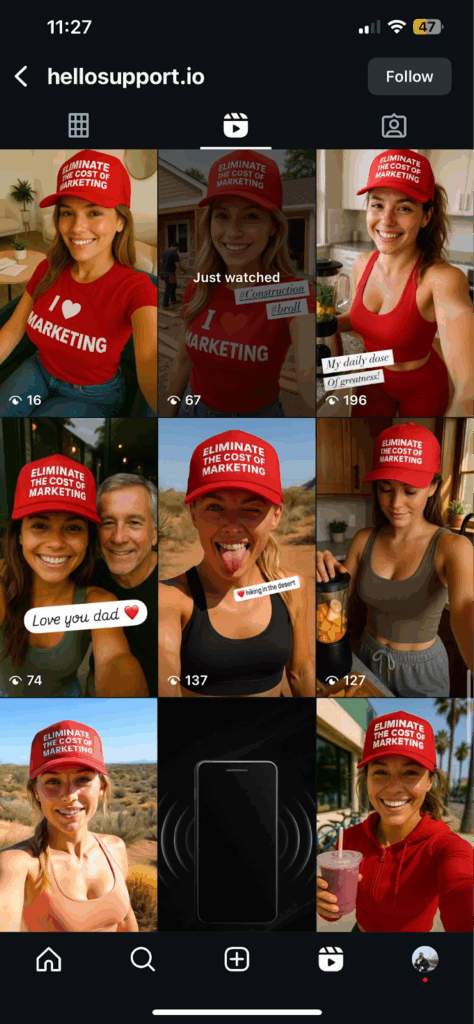
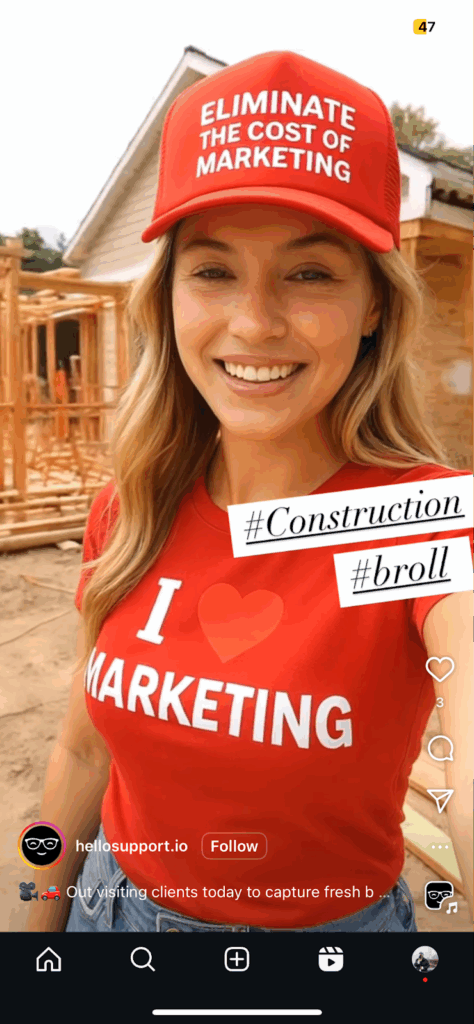
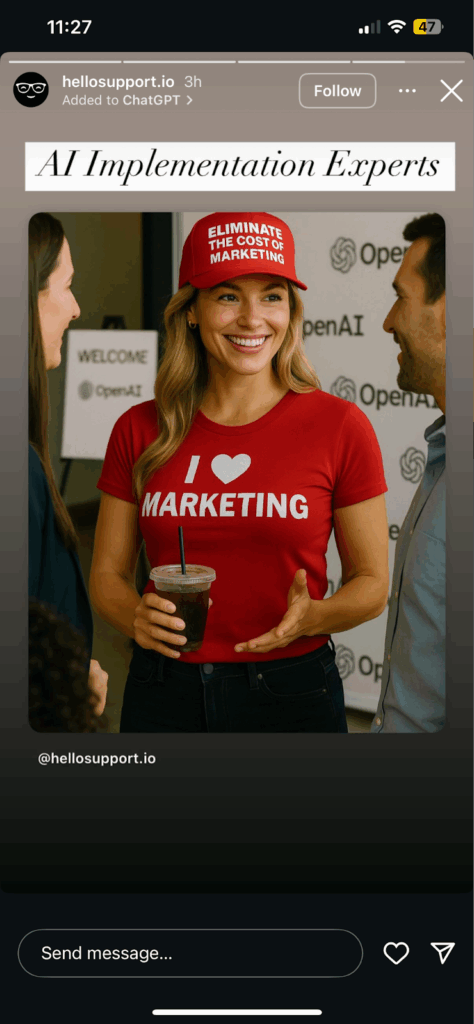
Ultimately, the desire to “eliminate the cost of marketing” is a product of these above conditions. The same way that Sweetgreen has gone from a unique salad experience to a foodstuff in a brown oval, it feels like marketing has less and less of a tangible impact on our world in this age of AI, algorithms, and hyperpersonal experiences, where everything is tailored or customizable exactly to who I am today. From the perspective of somebody outside of marketing who is looking to cut costs, it’s understandable how this type of AI content gets traction— platforms curate what we see anyways, so if the input can just be automated to the needs of the platform, then there’s less and less of a reason to make bold, strategic marketing expenditures. Further, as an AI user, once you get comfortable asking ChatGPT for help with an Excel formula or rewording a couple of bullet points on a client deck, it doesn’t feel at all like a reach to ask for a recommendation for a new pair of shoes or laptop— might as well turn over some marketing power to the algo as well.
All of this to say, we are fast approaching a critical mass with AI integration into marketing workflows, where the winners are about to start rejecting a lot of the recent status-quo, and instead take a balanced approach to using AI to do better work, not just more.
One of the biggest winners around the marketing world right now is Substack: a platform allowing users to pay for longform blog posts from their favorite writers, on topics ranging across personal, professional, and creative spheres. It sounds like a startup idea from 2002. Instead, it’s having a massive moment in 2025, truly, thanks to the growing number of people using it to resist the slop.
Sitting down to enjoy a longform post from somebody interesting is far from a new idea, but in our world of AI where all the answers and a lot of the strategy behind the media we consume comes courtesy of apathy-inducing LLMs, reading a post on Substack feels almost productive. It also happens to be one of the few digital experiences now which isn’t isolating, knowing that there is a real person on the other side of the computer, and a small audience of peers who you share something meaningful in common with. Ultimately, it is the rejection of this system of algorithmic-driven hyperindividualism that smart brand strategists are moving towards— it’s lonely to be the only one who has a particular feed. Consumers are looking to find their people again, and it’s up to brand leadership to define, with fresh eyes, who they’re for right now.
Remembering that a fundamental principle of marketing is that people don’t want to be themselves; they want to be a cooler, elevated, better achieving, better looking and feeling, better read, better dressed, and better performing version of themselves, a constantly updating feed that creates exact matches to what I already know and like, or an email campaign where everything is generated around a ‘vibe’ which AI thinks I already fit into, by definition cannot be the future— its stagnation.
Let Substack be a beacon to those in power in the marketing world that it’s time to reinvestigate brand promises and value props in spite of the pressure to automate and generate. Successful marketing is not a function of prompting and pressing buttons until sales come out of the business machine. The internet, and the marketing work we do around it, is doing a complete 180 on AI-enabled, perfectly tailored and individualized streams of content. Consumers are ready to return to a world with some friction, which takes some effort, but offers so much more value through meaningful storytelling and slow brand-building— in spite of the fever pitch which everything else seems to be hurdling at.
Sweb is, ultimately, and proudly, an AI-first agency. I spend time reading as much Adweek as I do WIRED, and have seen a tremendous benefit in my own career from being good at using AI. To that end, the team is smart with how we’ve integrated these tools— we lean on LLMs to achieve things that wouldn’t have been possible previously, and it drives real, meaningful results for our clients. What we are not, however, and what we continue to reject in doing this brand building for our clients, is an AI-agency. We use tools for executing, not strategizing, connecting, or creating.
Ultimately, it’s crucial to understand just what a turning point we’re barreling towards in terms of brand marketing and the technical verticals which support it. A shift is already happening— the new winners are curators, not contributors.